When a North Wales taxi and roadside recovery service came to us invisible on Google, we did not reach for a plugin. We built a system. Within months it was generating first-page rankings for 168 local search terms across the region. Here is exactly what we built, why it works, and what it means for any service business competing locally.
The problem nobody talks about in local SEO
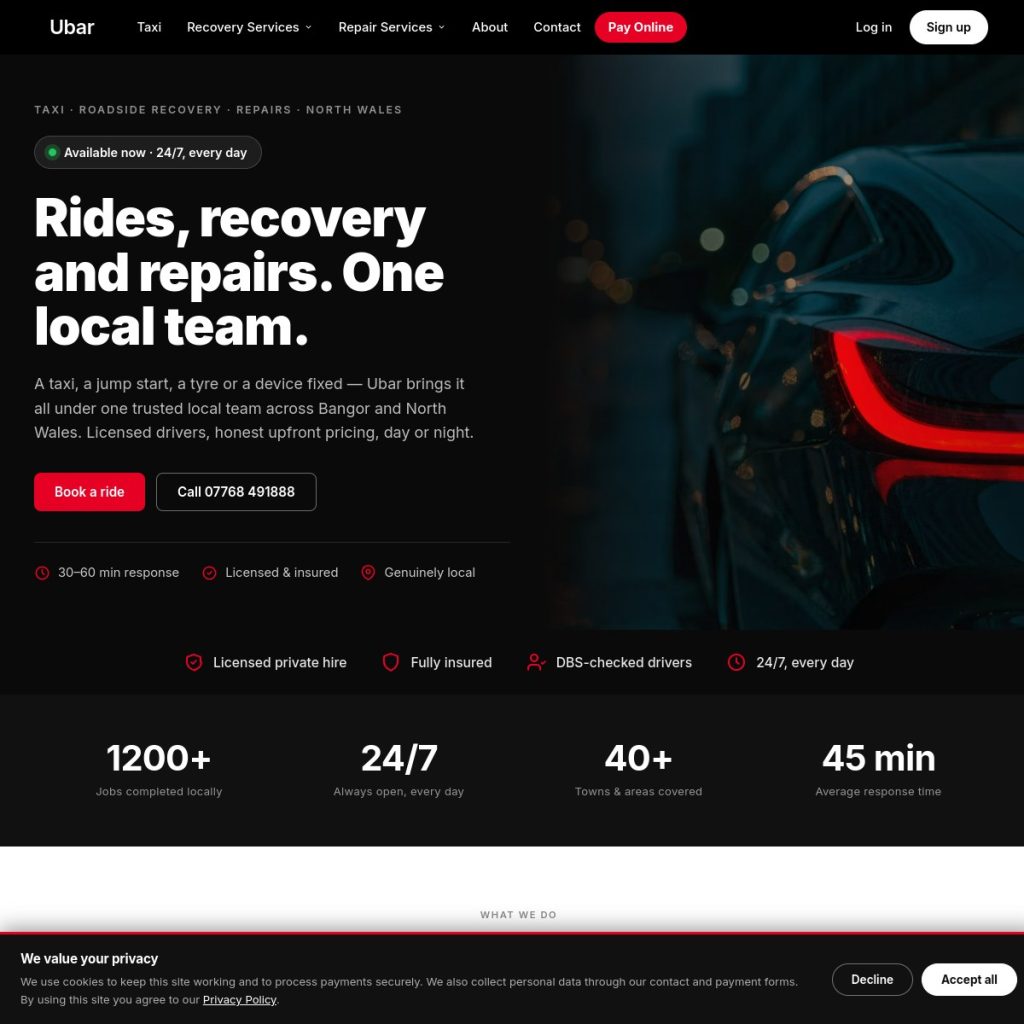
Ubar.uk runs 24-hour taxi, roadside recovery and device repair services across North Wales. When they approached us, their website mentioned Bangor. That was essentially it.
Here is the thing most service businesses do not understand about local search. If someone in Caernarfon searches for a taxi, they will not automatically find a business whose website only mentions Bangor. Google treats these as distinct locations with distinct user intent. You need a page for Caernarfon. You need a page for Llanberis. You need a page for Bethesda. One page covering your whole service area is not enough — it is the digital equivalent of a shop that refuses to put its address on the front door.
Ubar served dozens of towns across a wide geographic area. Writing individual pages manually for each one would have taken weeks of work and likely produced inconsistent, low-quality output. So we built a generator.
What programmatic local SEO actually is
The term sounds technical but the concept is simple. If you have one service and many locations, you build a template that automatically generates a properly structured, unique page for each location — rather than writing each page from scratch.
Travel sites have done this for decades. Job boards do it. Property portals do it. The reason most local service businesses have never used it is that doing it properly requires development capability most web agencies do not have — and most business owners have never been told it exists.
How we built the system for Ubar
Step 1: structured location data
We compiled every town, village and area Ubar genuinely serves across North Wales. Each entry in the dataset includes the place name, the county, the postcode district, and a short passage of unique descriptive content about that specific location.
That last element is non-negotiable. Google actively penalises thin pages that swap a place name into otherwise identical content. Every page must have something that makes it genuinely different from every other page. The unique local content is what separates a system that ranks from one that gets filtered out of the index.
Step 2: a dynamic PHP template
We built a custom PHP template into the Ubar WordPress theme that pulls from the location dataset and renders a complete page for each entry. Every page gets its own unique title tag, meta description, H1 heading, body content and schema markup — generated automatically, consistent in quality, impossible to distinguish from hand-written pages.
Step 3: schema markup on every single page
Each location page outputs three layers of structured data. LocalBusiness schema specifies the service area and contact details. BreadcrumbList schema gives Google navigation context. Service schema describes exactly what is offered in that location. Together these signals tell Google precisely what the page is about, where the business operates, and what a searcher can expect to find — all of which accelerates the time to ranking.
Step 4: a linking architecture that distributes authority
Every location page links back to the core service pages and cross-links to geographically adjacent pages. This does two things. It passes link authority from high-performing pages to newer ones. And it helps Google build an accurate model of the business’s real geographic coverage — which is exactly what determines how broadly the site ranks in local search.
What happened after launch
Within three months Ubar was on page one for local taxi and recovery searches across multiple North Wales towns. Not just Bangor. Towns across the region where the business actually operates but where it had previously been completely absent from search results.
The site now has 168 published location pages. Each one targets its own search term. Collectively they drive a consistent weekly volume of local enquiries — from customers searching in their own town for the exact service Ubar provides.
Nothing about the business changed. The service stayed the same. The team stayed the same. The prices stayed the same. What changed was the structure of the website — and the search traffic responded to that almost immediately.
Could this work for your business?
If your service business covers more than one town and your website does not have dedicated pages for each area you serve, the honest answer is yes — you are leaving significant local search traffic to competitors who do have those pages.
The scale of the opportunity depends on your service area. A business covering 20 towns is leaving 20 potential first-page rankings uncaptured. A business covering 100 towns is leaving 100. The pages can be built and ranking before a single competitor realises what has happened.
The system works on WordPress with proper custom theme development. It does not work reliably with page builders or off-the-shelf plugins — the technical requirements are specific enough that they need to be built into the theme directly. But once built, the system generates pages indefinitely as you expand your service area, with no additional development cost per page.
If this sounds like something your business needs, learn more about our local SEO service or get in touch for a free consultation. We will look at your current site, your service area, and tell you honestly whether a programmatic approach makes sense for your situation.
Common questions about programmatic local SEO
Will Google penalise programmatically generated pages?
No — provided the pages contain genuinely useful, unique content. Google’s helpful content system targets pages that exist purely for search engines rather than real users. Pages with real local information, proper schema and genuine service descriptions pass that test comfortably. The issue arises only when businesses generate hundreds of pages that are word-for-word identical except for the place name — which is exactly what our approach avoids.
How many location pages do you need?
One for every location you genuinely serve. Creating pages for places you do not actually cover is a waste and risks damaging your credibility. The goal is to match your real service footprint to your digital one — precise, accurate and comprehensive.
How quickly can location pages rank?
Properly structured pages with schema markup typically start appearing in local results within six to twelve weeks. In less competitive areas — which covers most UK towns outside the major cities — the timeline is often faster. Results compound significantly over time as the pages build authority.
Does this replace a Google Business Profile?
No — it works alongside one. The GBP drives rankings in the map pack at the top of local results. Location pages drive rankings in the organic results below it. Both matter and both reinforce each other. Running both together gives you the maximum possible local search presence.